Australian Cocktail Bars Have Japanese Flair
From precise ice to the vinyl revival, we owe more to Japanese bars than you might expect. And a century-old cocktail manual is partly responsible.
Words by Lee Tran Lam · Published on 16 Feb 2026
Have you ever met a cocktail historian before? I hadn’t until I stepped into Bar UK in Japan last year.
Located in a basement in Osaka’s Kita ward, the tiny cocktail bar fits 11 people at a squeeze – yet there are 1300 spirits on display. “I have quite a few old bottles from the 1970s to 1990s,” says owner Eiji Arakawa, who opened Bar UK after working for one of Japan’s oldest newspapers for 37 years, as a way to share his whisky collection with others.
Flipping through the encyclopedic menu of Western standards, Japanese classics, forgotten cocktails and house creations, you realise Arakawa’s drinks knowledge is deeply archival. It’s appropriate, then, that a century-old Japanese cocktail book is what led me to Bar UK's door.
Kokuteeru (a rendering of the Japanese pronunciation of the English word “cocktail”) was published in 1924 by bartender Yonekichi Maeda, and was one of the first Japanese cocktail recipe books – and preceded Harry Craddock’s seminal The Savoy Cocktail Book by six years. But unlike Craddock’s bartending bible, Kokuteeru essentially vanished before World War II, and its “contents were largely unknown within Japan's bar industry,” says Arakawa.
Bar UK, Osaka. Photo: Will Reichelt
In 2011, Arakawa spent four months translating a second-hand copy of Kokuteeru into modern Japanese on his blog. A decade later, he worked with Perth bartender Brendan Scott Grey and British historians Anistatia Miller and Jared Brown, on an English translation. The sales of this edition funded the Yonekichi Maeda Scholarship, which sends Australian bartenders to train at Tokyo’s legendary Bar High Five.
It was one of them, Jac Landmark from Bar Love in Perth, who enthusiastically recommended Bar UK to me. “I’ll never forget it,” says Landmark of their time with Arakawa, who generously explained Bar UK’s huge menu and counter setup. “I also happened to visit towards the end of his shift, so he even took me out to another bar and for dinner after he’d closed. He may seem older, but he can walk very fast.”
Without Kokuteeru, Landmark might never have found Bar UK, and neither would I. This rare book – which has still never been reprinted in its native Japanese – has influenced the itineraries of many Australian travellers, and transported bartenders (Landmark in 2023, Lucky Chan’s Sujit KC the following year) to Japan – a century after Maeda wrote about juleps, sours and punch.
Jac Landmark
Though bar culture was introduced to Japan by the West (George TM Purvis, Jane Austen’s great nephew, is believed to have poured Japan’s first cocktails in Yokohama in the 1870s), what’s shaking there has an undeniable ripple effect in Australia.
For Takashi Matsumoto, it’s the “precision and care for the smallest details” he loves about Japanese bartending, and cites Sydney’s Bar Sumi and Kahii as shining examples. At Dean & Nancy On 22, where his Hokkaido-inspired Whisky Sour is prize-winning, Matsumoto concentrates on how he stirs (“slow for a more layered result, faster and colder for sharper drinks like a Martini”) and considers ice placement. “I try to focus on those little things every day,” Matsumoto says.
It's something you’ll see a lot in Japan – a strong dedication to making incremental improvements as a matter of routine, says Nicholas Coldicott, an expert on Japanese bar culture and author of Tokyo Cocktails. “That’s the reason a ramen broth can get people so excited, but not, say, the gravy in a diner abroad. One is an endlessly refinable craft. The other is something that, once it tastes good, it’s good.”
Coldicott says that while there are countless ways to experiment in bartending, the Japanese approach to the craft is about “finding ways to make something a tiny bit better, knowing that if they succeed, most people won’t even notice”. For example, Takao Mori, of Mori Bar in Tokyo, was famous for stirring his Martinis briskly 100 times. Meanwhile, Keiichi Iyama, creator of the Yukiguni cocktail, was shaking and pouring into his nineties – a level of dedication Japan’s shokunin (artisans) are famous for.
+81 Aizome, Brisbane. Photo: Courtesy of +81 Aizome
At +81 Aizome, named by Broadsheet as one of Brisbane’s best new bars of 2025, manager Tony Huang uses pure Kuramoto Ice from Kanazawa in his elegant “neo cocktails”, tempering the cubes with a hand fan before handcutting them to size. “Japan has reshaped global bar culture by elevating bartending into a craft grounded in philosophy,” Huang says.
Omotenashi – the “spirit of wholehearted hospitality” – is a key component Huang witnessed at Tokyo institution Bar High Five, where owner Hidetsugu Ueno (“the most influential Japanese bartender ever” according to Coldicott) is famous for his tin-shaking flair and ice sculpted into glimmering diamonds. “Each cocktail was treated as an ichigo ichie moment,” says Huang, “a once-in-a-lifetime encounter between bartender and guest.”
Landmark trained at High Five as part of their scholarship, and was also struck by Ueno’s impeccable standards. “They really have thought of everything,” says Landmark. “Each customer gets a glass of water with small, cubed ice. When the glass was empty and placed down, the staff would hear the sound of the ice and know to go refill their glass.”
When Michael and Zara Madrusan opened The Everleigh in Melbourne in 2011, they imported the exacting focus on craft and service that Michael learned under mentor Sasha Petraske at New York’s Milk & Honey. Petraske himself was “largely influenced by the use of ice, and the ceremony around service and precision” found in Japanese bartending, says Michael, who adds that speakeasies like Milk & Honey and The Ev are comparable to “hidden apartment-style bars cities like Tokyo are famous for”.
Bar Selecta, Melbourne. Photo: Chege Mbuthi
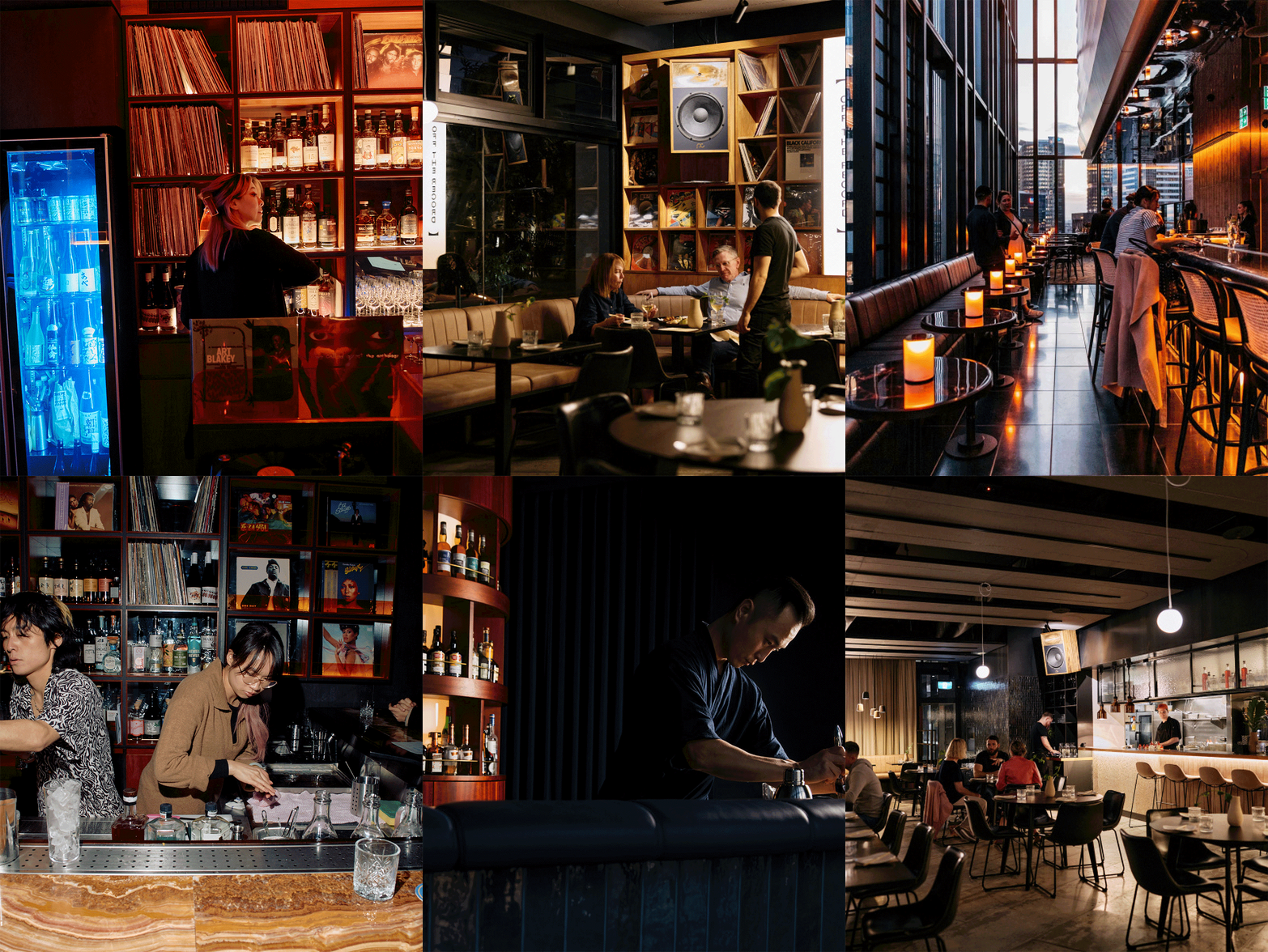
Zara, who co-authored The Madrusan Cocktail Companion, points to the explosion of vinyl bars modelled after Japan’s jazz kissa as a more recent example of the country’s enduring influence on local bar culture. See Melbourne’s Bar Selecta, Sydney’s Ante and Brisbane’s Ruby, My Dear.
“Japan has modelled cultural values surrounding quality and a carefully curated hospitality experience with these venues – a focus on more than just the drink, but the broader sensory experience,” Zara explains. “It’s a trend that is definitely continuing to evolve in Australia.”
Zara says there’s another big reason why facets of Japanese bar culture, such as listening bars, have become “incredibly influential” in the last few years: “Japan is obviously more accessible than Europe, for example, and feels a more sustainable choice for travel and exploration.”
Landmark has an even simpler explanation for the trend. “People love Japan.”
About the author
Lee Tran Lam is one of Australia's leading food journalists. She's also the host of the Culinary Archive podcast and Should You Really Eat That?
Related Content

-a2c7832d08.gif)