Design: Ben Siero
Online Retailers Are Ditching Free Returns – Which Might Be a Good Thing
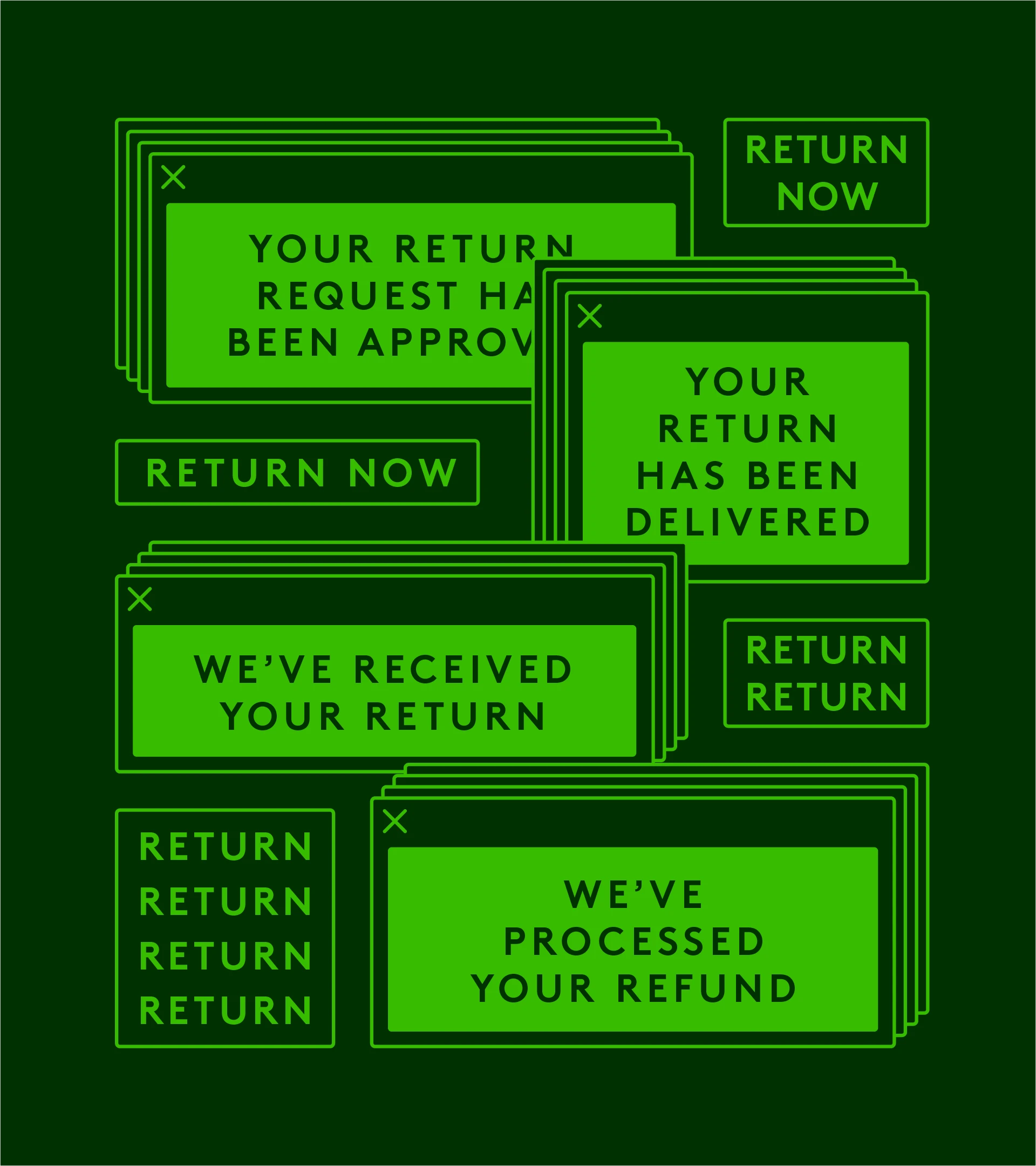
Free returns aren’t the future – frictionless returns are.
Design: Ben Siero
Words by Maggie Zhou · Published on 04 Mar 2026
We’ve become accustomed to free returns when shopping online, but they come with a hidden cost to retailers, customers and the environment. Some retailers aren’t buying it. And the age of expecting free online returns might be behind us.
“I don’t really like the culture of buying something without intention,” Jasper Mutimer tells Broadsheet. Since launching in 2019, his internet-led label Mutimer has offered free worldwide shipping, but no change-of-mind returns.
“Often those things get put into a pile and can’t be re-sold,” he says. “I just don’t really want people buying a bunch of stuff, trying it on and then returning it. And then if they return it without tags or without a bag or it’s clearly been worn, then there’s nothing we can really do with it except donate it, which is not a cycle that we’re trying to encourage.”
Julie Tengdahl, founder of Brisbane slow fashion label Tengdahl, offers customers in-store change-of-mind refunds within a week of purchase. After a week, Tengdahl provides store credit only. Customers have to email or call for an online return, plus cover return shipping costs. “[If] someone brings the purchase back 30 days later, you can’t sell it,” Tengdahl says. She says the seven-day timeframe is “sort of a respect thing too”.
The label has been around since 1986 and began selling online in 2005. Its return policy hasn’t changed in that time. Tengdahl says customers are comfortable with paying for return postage. “They also understand that we’re a small business. We’re actually posting one [parcel] back, so we’ve posted twice.” While these small owner-operated labels can afford to be principled, they’re emblematic of a broader shift in the industry. Global retailers like Zara and Asos have also charged online returns fees for the last few years.
Locally, it now costs around $10 to return a Country Road, Aje, Henne, Camilla and Marc, Cue, Showpo, Vrg Grl, Dissh or White Fox order. For retailers like Viktoria & Woods and Arcina Ori, this figure hikes to $20. Still, some retailers hold firm on their free online returns, such as Cotton On and RM Williams.
According to logistics software provider Shippit’s 2026 report, the percentage of all Australian retailers offering free online returns dropped from 49 per cent in 2018 to 14 per cent in 2025. This doesn’t bother customers as much as you might expect. The expectation has shifted from free returns to smooth after-sales experiences. Almost four in five Australians rank the post-purchase experience – that’s tracking, delivery and seamless returns – as “very important” or “extremely important”.
Refundid is an ecommerce platform that aims to streamline returns and exchanges for customers and for retailers like Dissh, Country Road, Seafolly and Showpo. It prides itself on removing friction from these post-purchase processes, and on the additional insight it can provide retailers. “[These] can be used to refine fit, descriptions and positively impact future buying behaviour, data-backed decisions that help solve the reason for return in the first place,” Jenna Cohen, Refundid’s Australia and New Zealand general manager, says.
For retailers with a bricks-and-mortar presence, in-store returns are often encouraged to avoid the hassle of extra shipping, packaging, fulfilment and processing costs. Many retailers also encourage exchanges and store credit over the refund process – this way, the monetary value is retained within the business.
Bared Footwear has gone even further, with a policy that promises to “never leave you in shoes you don’t love”. “Rather than just sending a return-to-sender label with the shoes, we offer our customers the option to try more styles for free. They get to try alternative styles at home and then send back any shoes that aren’t right,” says founder and CEO Anna Baird.
On average, about half of Bared’s customers who request a return end up changing and opting for an exchange. Baird says 75 per cent of customers who receive a refund become repeat customers. It’s “incredibly expensive” and time-consuming, but it ensures a positive customer experience.
In place of free returns, there’s a focus on frictionless returns instead. “Free returns [don’t] always equal a great experience, and it’s certainly not a sustainable business model for retailers,” says Mareile Osthus, co-founder and CEO of Humii, a platform that helps retailers optimise their online shop. “What shoppers truly value is a seamless, low-contact process – an intuitive returns portal, print-at-post labels, resealable packaging and clear communication.”
Tengdahl and Baird agree. “In a spiritual sense, it’s good karma to make sure the client’s happy,” Tengdahl says.
And Baird argues money isn’t the only price that comes with returns. “Returns are expensive, no doubt. But I think the bigger issue is around connection,” she says. “If a customer doesn’t feel looked after and heard, they will take their money elsewhere … Our policy actually makes you talk to us. It’s a bit old-fashioned, but it gives us the chance to find out what they are not liking and offer alternatives. It also helps us to apologise if something is not perfect.”
About the author
Related Content